
PROJECTS
Project profiles from across our portfolio of energy efficiency and indoor air quality deployments.
Project Profiles
From SUNY laboratory buildings to Western New York commercial facilities, our projects demonstrate measurable results — lower energy costs, healthier indoor environments, and attractive returns on investment through utility incentive programs.
 Wireless Energy Management Manufacturing
Voss Manufacturing
Lockport, NY
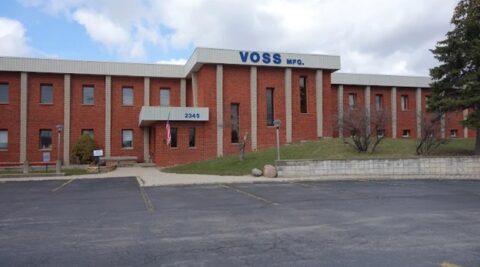
Voss Manufacturing operates two buildings in Lockport and is ISO 9001 certified. Their sustainability-minded management recognized the opportunity to operate HVAC systems more efficiently. Green Building Partners, introduced through Energy Mark's consortium, developed a turnkey wireless energy management system (EMS) to reduce waste during unoccupied hours. The project included utility incentive management, savings estimates, ROI analysis, and full implementation support. In-house electricians installed 48 communicating thermostats throughout office RTUs and plant ceiling-mounted gas-fired heaters. GBP provided wiring diagrams, installed wireless infrastructure, and configured the dashboard with weekday/weekend scheduling.
 Wireless Energy Management Healthcare
Atwal Eye Care & Buffalo Ambulatory Service Center
Buffalo, NY
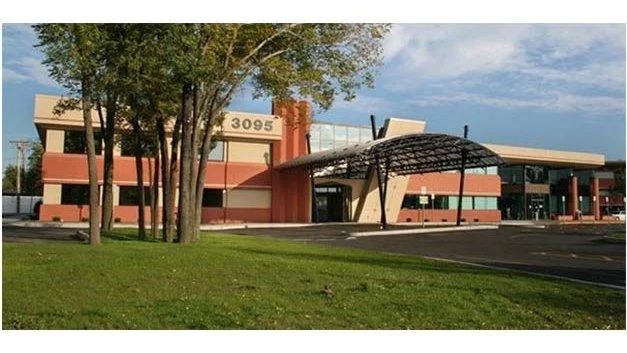
Atwal Eye Center has a staff of over 90 associates including highly experienced surgeons. Their 32,000 sq.ft. headquarters at 3095 Harlem also includes space leased to Buffalo Ambulatory Service Center, plus 4 branch offices. GBP deployed a wireless EMS to reduce HVAC waste during unoccupied hours, with utility incentive management and ROI analysis covering 100% of occupied spaces. A real-time IAQ monitoring program was added consistent with WELL Building Institute requirements. Atwal utilized National Grid's low-cost finance program (Verdant Capital) — monthly utility savings exceeded the monthly lease payment, making the project cashflow positive from day one. This project was cited by the Western New York Sustainable Business Roundtable as an example of achieving carbon reduction and advancing health and wellness, earning the Innovator of the Year Award.
 Wireless Energy Management Municipal / Parking
Buffalo Civic Auto Ramps
Buffalo, NY
Since 1954, Buffalo Civic Auto Ramps (BCAR) has managed downtown Buffalo parking facilities as a nonprofit entity. After LED lighting upgrades in 2018, management sought additional efficiencies through lighting controls. Prior to controls, all levels were illuminated continuously — even when unoccupied. GBP partnered with Intellastar (Entuit wireless devices) to implement daylight harvesting (wireless, battery-less lumen sensors on perimeter circuits) and motion/lumen sensors on upper levels that activate only when triggered. National Grid custom incentives of $9,084 reduced the project cost by 45%, yielding a 2.7-year simple payback on annual savings of $6,241.
 Wireless Energy Management Education
Buffalo Collegiate Charter School
Buffalo, NY
Buffalo Collegiate Charter School is a tuition-free SUNY Charter Schools Institute member that opened in 2018. During a gut rehab of the 42,500 sq.ft. building, HVAC automation was value-engineered out due to budget overruns. GBP proposed a wireless automation system replacing conventional lighting and HVAC controls at a fraction of the price. The Intellastar platform provided wireless, battery-less light switches and occupancy sensors (saving conduit labor), centralized lighting control (one controller vs. per-room), and wireless thermostats with centralized night/weekend/holiday setback programming. Submetering was later added at low cost using the same gateway infrastructure.
 IAQ Sensor Platforms Higher Education
SUNY Oneonta – Physical Science Building
Oneonta, NY
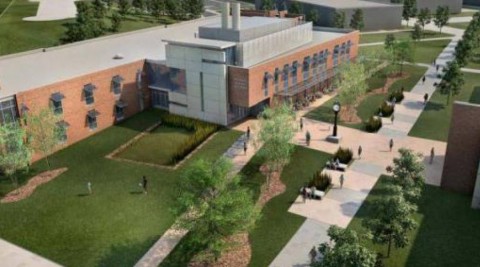
The Physical Science Building at SUNY Oneonta completed a major renovation in summer 2017. Existing 12-foot floor-to-floor height constraints required creative infrastructure solutions. Ellenzweig/BR+A's design incorporated Aircuity's real-time air quality assessment, enabling lower air change rates consistent with ASHRAE 2015 Laboratory Guidelines for demand-based control and SUCF directives for active sensing. Aircuity and chilled beams enabled a reduction in primary equipment and a shallow ductwork distribution network. Post-occupancy data confirms 90 kBtu/sf/year energy use intensity — 10% better than predicted — rendering the building 67% carbon neutral relative to the US average for this building type. This was the 7th SUNY building project for Green Building Partners and Aircuity.
 IAQ Sensor Platforms Higher Education
SUNY Binghamton – Engineering & Science Building
Binghamton, NY
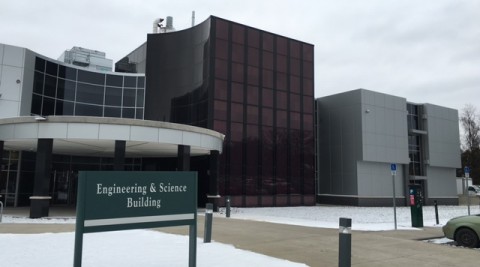
HVAC typically accounts for 50–70% of total operational cost in lab buildings. Binghamton University's facility planning department identified lab conservation as the most impactful campus energy reduction strategy. When 2011 ASHRAE lab guidelines were released allowing variable air change rates (ACH) based on continuous air quality monitoring, SUCF supported the updated approach — making Binghamton the first SUNY campus to implement Aircuity's OptiNet® system. The system continuously monitors IEQ in lab spaces and sends smart signals to the BMS to adjust ventilation rates to actual conditions, saving energy while ensuring a safe, comfortable environment for researchers.
 IAQ Sensor Platforms Higher Education
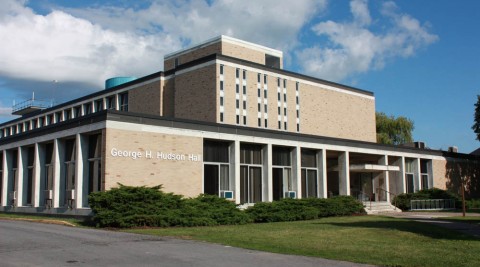
SUNY Plattsburgh – Hudson Hall
Plattsburgh, NY
Hudson Hall is one of two main science buildings on the SUNY Plattsburgh campus. Green Building Partners identified it as an ideal Aircuity application and the system was installed in all lab areas. Air change rates were reduced from 6–7 ACH to a baseline of 3–4 ACH, increasing only when additional fresh air is needed. Beyond energy savings, the project resolved a persistent moisture issue with microscopes caused by chillers unable to keep up with cooling requirements. With ventilation rates matched to actual space needs, SUNY Plattsburgh's EH&S department confirmed the moisture problem was eliminated.
 IAQ Sensor Platforms Higher Education
SUNY Binghamton – Center of Excellence
Binghamton, NY
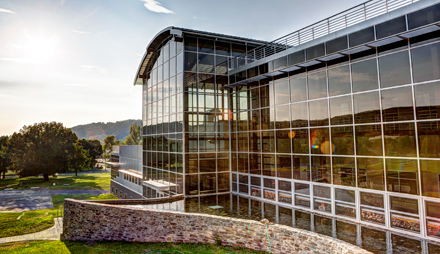
The $30 million, 114,000 sq.ft. Center of Excellence at Binghamton University's Integrated Technology Complex houses the NY State Center of Excellence in Small Scale Systems Integration and Packaging (S3IP). The two-story glass, metal and stone building features open laboratory space, a 140-seat Symposium Hall, and offices. Built to LEED standards, the Aircuity OptiNet system controls outside air quantities across 38 zones. Additional sustainable features include energy-efficient windows and skylights, a water retention system, penthouse-mounted mechanical systems, heat recovery and humidity control, a U-shaped atrium with natural ventilation, adaptive cooling, hydronic heating, radiant floor heat, and a recirculated water feature.
 IAQ Sensor Platforms Transportation / Transit
Rochester Genesee Regional Transportation Authority
Rochester, NY
Transit facilities like RGRTA are typically designed with high ventilation levels to diffuse diesel fumes, particles, CO, and other contaminants. However, contaminants are not always present — providing maximum ventilation when air is clean wastes significant energy. Bergmann Associates specified Aircuity's Centralized Demand Control Ventilation (CDCV) system, which transports air samples from busways and concourse locations to laboratory-grade instruments in a central location. This reduced the required sensor count from 141 to just 32, dramatically lowering first cost, integration complexity, and ongoing calibration/maintenance costs. The Aircuity service program includes semi-annual calibration and sensor replacement at no additional charge.
Ready to Add Your Building to This List?
Let's start with a conversation about your building's energy and indoor air quality goals.